Key Points
- Taiwan Semiconductor insiders, including its CEO, CFO, and COO, have accelerated open-market share purchases in early Q3, signaling strong confidence in the company's outlook.
- Strong Q2 results and guidance, driven by steep ramping of 2nm process technology for AI chips, prompted analysts to raise price targets and issue a consensus Buy rating.
- Taiwan Semiconductor's growth is expected to be sustained for years as AI inference demand accelerates and hyperscalers ramp up spending on advanced chip technologies.
Insider buying isn’t the signal it used to be, with strict laws governing insider activity and trades often executed through prearranged plans, but Taiwan Semiconductor (NYSE: TSM) is sending a classic signal. Insiders aren't just buying; their purchases are picking up speed in early Q3, and in many cases, they're open-market buys. Open-market purchases mean insiders are using their own money to buy TSMC shares, reflecting strong confidence in the outlook. The outlook is underpinned by AI, robust demand across the infrastructure stack, and expansion plans that point to accelerated growth and profitability.
Who’s buying? A broad-based grouping that includes the chief executive officer (CEO), chief financial officer (CFO), chief operating officer (CFO), and a plethora of senior and regular vice presidents (VPs). However, one insider sold in 2026, which should be noted, but it does not present a red flag for investors.
Tzu-Sou Chuang is a vice president of plant operations who’s been with the company since 1995, years before the New York stock listing, and vested in shares dating back to then, when TSMC's market price was in the $5 range. In this scenario, he’s looking at thousands of basis points in gains and has ample incentive to sell. While his 2026 sales were robust, he still holds hundreds of millions worth of shares. Other insiders have shorter tenures and greater incentive to invest in the company, given its position in the AI ecosystem.
Taiwan Semiconductor's Guidance Update Triggers Bullish Reset
Taiwan Semiconductor's Q2 results and guidance were strong, triggering a bullish reset among analysts. Robust demand, centered on advanced technologies, underpinned the results, with signs pointing to increased adoption in upcoming quarters. The guidance, which came in well above MarketBeat’s consensus at the midpoint, is grounded in the forecast for “steep ramping” of 2nm processes during the quarter. 2nm technology is critical for AI, packing about 50 billion transistors into a stamp-sized space and enabling faster speeds with lower power consumption.
As it stands, Advanced Micro Devices (NASDAQ: AMD) MI450X is the first AI GPU built on the 2nm standard. Among the catalysts for TSMC is the official commercial launch of MI450 and initial deliveries, scheduled for Q3 2026 (the current quarter). AMD’s foray into rack-scale architecture (Helios) positions it to claim immediate AI market share, especially in the inference segment, as hyperscalers lean into the lower-cost/higher-performance product.
Forecasts for inference vary, but agree it will be a far larger market than model training, with the infrastructure expected to grow at a high double-digit compound annual growth rate (CAGR) through the middle of the next decade. Inference infrastructure is expected to more than double the model-training market, setting the stage for explosive growth at TSMC and AMD over the coming quarters.
And Advanced Micro Devices is only part of the calyast. Taiwan Semiconductor also manufactures products for Cerebras Systems (NASDAQ: CBRS), a key link in the AMD-inference chain. Cerebras’ extra-large, inference-focused chips are designed to integrate natively with Helios racks, enabling lightning-fast token generation without high-bandwidth memory (HBM). Its latest earnings report revealed hyper-demand and acceleration tied to partners such as OpenAI and Amazon’s (NASDAQ: AMZN) AWS.
Analysts responded positively, highlighting the long-term opportunity and expansion plans, along with typical concerns, including front-heavy spending plans and macroeconomic uncertainty. Even so, the positives outweighed the risks, leading to numerous price target increases and upgrades, with the trend extending into early August. As it stands, the group rates TSMC as a consensus Buy with an 87.5% Buy-side bias and sees it moving to the high end of its range, which tops out at $650 as of mid-August.
Taiwan Semiconductor Is Set Up for Sustained Strength
The market is getting the nature of this opportunity wrong; it's more than a cyclical upswing in semiconductors. AI has changed everything: the way computing works, the Internet and agentic assistance. While the industry is shifting to inference, we’re still in the earliest phases, and model-training capacity is still being built.
Much of the planned spending (by hyperscalers and neoclouds) is based on NVIDIA’s (NASDAQ: NVDA) Vera Rubin architecture, which won’t be available until 2027, and NVIDIA is already planning its next generation, which will skip the 2nm process in favor of the next technology, 1.6 nm. The takeaway is that TSMC will sustain business strength for the foreseeable future and potentially for the next decade or longer as AI capacity is unleashed and the technology advances.
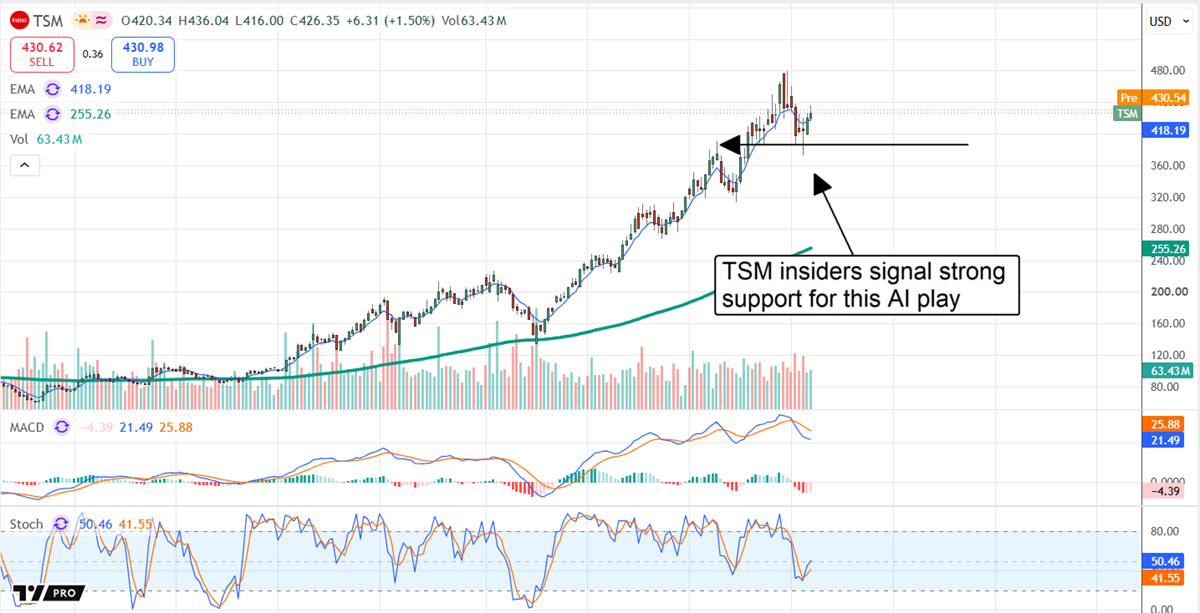
Taiwan Semiconductor's price action reflects a summer 2026 peak but remains bullish otherwise. The market is in a robust uptrend, underpinned by steady volume, and the summer pullback found support in late July. The August story is that TSMC shares are rebounding in line with the underlying trend, with catalysts ahead. Among them is NVIDIA’s late-August earnings report, and any report revealing solid, unbroken, or improving AI demand.
Companies in This Article:
| Company | Current Price | Price Change | Dividend Yield | P/E Ratio | Consensus Rating | Consensus Price Target |
|---|
| Taiwan Semiconductor Manufacturing (TSM) | $430.33 | +0.9% | 0.69% | 31.05 | Buy | $524.25 |

Experience
Thomas Hughes has been a contributing author for InsiderTrades.com since 2019.
- Professional Background: Thomas Hughes is the Managing Partner of Passive Market Intelligence LLC, a market research platform he launched in 2023 with the mission: “We watch the market so you don't have to.” He has worked as a blogger, stock market commentator, and independent analyst since 2010 and has been actively involved in trading and investing since 2005.
- Credentials: He holds an Associate of Arts in Culinary Technology—training that honed his discipline, attention to detail, and ability to anticipate outcomes, all of which carry over into his work as a market analyst.
- Finance Experience: Thomas has been writing about finance and investing since 2011, when he discovered it could be more than a personal passion—it could be a profession. He’s been a contributing writer for InsiderTrades.com since 2019.
- Writing Focus: He specializes in the S&P 500, small-cap stocks, dividend and high-yield strategies, consumer staples, retail, technology, oil, and cryptocurrencies. His analysis blends chart-based technical setups with key fundamental insights, helping readers identify actionable trends.
- Investment Approach: Thomas takes a hybrid approach that combines technical analysis with deep fundamental research. He often writes about macroeconomic shifts, earnings trends, and sentiment-based trading signals.
- Inspiration: Thomas first became interested in stocks after attending a seminar on how to buy and sell your own shares. That event opened his eyes to the market's potential and sparked a lifelong interest in investing.
- Fun Fact: Thomas took up model railroading by accident a few years ago—and now he can’t stop running the rails.
- Areas of Expertise: Technical and fundamental analysis, S&P 500, retail and consumer sectors, dividends, market trends
Education
Associate of Arts in Culinary Technology
