Key Points
- Upstart insiders own a considerable exposure and are buying shares in May.
- Numerous catalysts exist to accelerate growth and profitability.
- Near-term headwinds exist, but analysts and institutions are buying into the long-term forecast.
Insiders are buying Upstart (NASDAQ: UPST), highlighting two interesting stories. The first is the sort of CEO transition that investors normally can only dream about. The transition is from one founder to the next, ensuring the stability of vision, and from one generation to the next, ensuring long-term tenure.
The takeaway is that these insiders, including the outed and newly seated CEO, bought shares in May, even though they didn’t have to, as they already had substantial exposure to this fintech stock.
Upstart is an AI-powered lending platform. It is not a financial institution per se, but a loan originator using a cloud-based, AI-enabled platform to qualify consumers and connect them with loans. The platform provides numerous utilities to the industry and consumers, including higher approval rates, lower risk, more efficient operations, 90% of all loans fully automated, and lower-cost loans for consumers.
Analysts and Institutions Buy Into Upstart’s Long-Term Outlook
Analysts and institutional trends underscore the opportunity highlighted by the insiders. InsiderTrades tracks 16 analysts who rate the stock a consensus Hold. However, the tepid rating is offset by a 44% Buy-side bias and opportunity for 55% upside at the consensus.
The bad news is that consensus has fallen on a trailing 12-month basis, playing into the tepid stock price action, but recent revisions suggest the trend is over. Revisions released since the May 5, 2026, earnings report include some price target reductions and initiations, but both are to levels aligning with the consensus, forecasting approximately 55% upside.
Institutional trends reveal a solid support base that has accumulated shares since the IPO. The critical details include the 63% ownership rate, activity ramping in 2025 and again in early 2026, and the balance of activity. Institutions are accumulating at a pace greater than $2-to-$1 and provide a strong market tailwind. The price action would be more bullish if not for the robust short interest.
Short sellers have leaned into this market due to its interest rate exposure, arguing that its untested algorithm sets it up for failure. The flip side is that high short interest, at 33%, also sets the stock up for short squeezes, given positive catalysts, many of which are on the horizon. The primary catalyst this year was securing over $4 billion in committed capital. The deal, which includes Fortress and Centerbridge, derisks the outlook, reducing exposure to spot market rates and their impact on margins. Expansion into new verticals is also expected to drive growth, as is the move towards bank status.
Upstart: A Rising Start in Fintech
Upstart announced earlier this year that it had applied for a National Bank Charter. Still under review, the charter would enable Upstart to hold deposits, provide easier access to capital, and allow for a stable lending rate schedule. The impact on the business would be substantial, reducing risk, accelerating growth, and stabilizing the profitability outlook, effectively bypassing 50 individual state regulators in favor of Federal oversight.
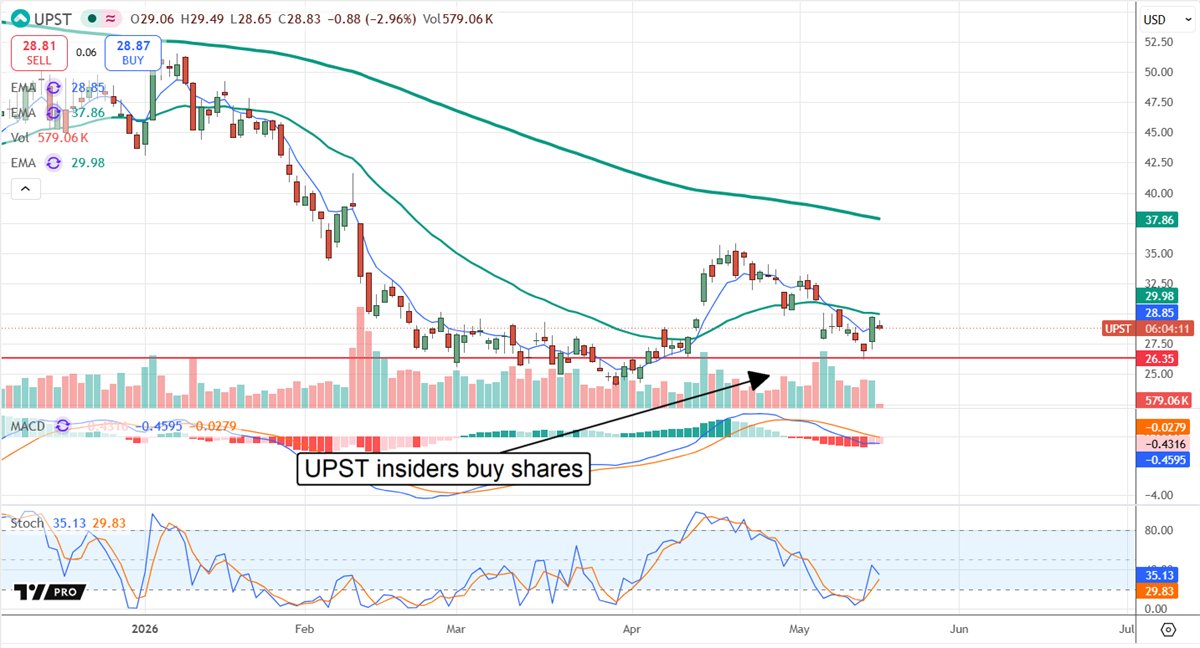
The price action reflects a potential bottom, but no clear sign of a reversal. The bottom is near $26.35 and is unlikely to be broken. The bad news is that this market may continue to wallow at its current levels until a more potent catalyst emerges. As it stands, the company is growing, outpacing consensus estimates, but profitability is erratic and fell short in the latest report.
Upstart: Hurdles Versus Catalysts in 2026
Upstart’s biggest hurdle may be itself. The company’s AI models are effective, but class-action lawsuits allege they are also responsible for the company's business weakness. Lawsuits filed in early 2026 claim the Model 22 upgrade was overly sensitive to macroeconomic signals, leading to significant declines in approvals, revenue, and earnings. The risk this poses for investors now is twofold: the risk of change and the risk of no change to the models.
Other risks include competition. While Upstart continues to gain traction, competitors including Sofi Technologies (NASDAQ: SOFI) and Affirm (NASDAQ: AFRM) continue to dominate the field. Their strengths lie in consumer loans, impacting Upstart’s addressable market, with Affirm’s point-of-sale model taking share before consumers even need a loan. Upstart’s advantages include higher approval rates and turnkey integrations.
What is the market getting wrong about Upstart? What the market gets wrong is that Upstart isn’t just some cyclically exposed fintech with interest rate risk but a scalable AI platform. While near-term hurdles exist, the long-term outlook includes rapid expansions into new verticals, including HELOCs and automotive. Additionally, the 2026 margin compression is due in large part to timing issues, not fundamental defects, and front-loaded reinvestment into growth verticals. The likely outcome is that this company continues to grow robustly in the upcoming years, fine-tuning its algorithm as it accelerates growth and profitability.
Companies in This Article:
| Company | Current Price | Price Change | Dividend Yield | P/E Ratio | Consensus Rating | Consensus Price Target |
|---|
| Upstart (UPST) | $27.94 | -5.3% | N/A | 73.53 | Hold | $45.79 |

Experience
Thomas Hughes has been a contributing author for InsiderTrades.com since 2019.
- Professional Background: Thomas Hughes is the Managing Partner of Passive Market Intelligence LLC, a market research platform he launched in 2023 with the mission: “We watch the market so you don't have to.” He has worked as a blogger, stock market commentator, and independent analyst since 2010 and has been actively involved in trading and investing since 2005.
- Credentials: He holds an Associate of Arts in Culinary Technology—training that honed his discipline, attention to detail, and ability to anticipate outcomes, all of which carry over into his work as a market analyst.
- Finance Experience: Thomas has been writing about finance and investing since 2011, when he discovered it could be more than a personal passion—it could be a profession. He’s been a contributing writer for InsiderTrades.com since 2019.
- Writing Focus: He specializes in the S&P 500, small-cap stocks, dividend and high-yield strategies, consumer staples, retail, technology, oil, and cryptocurrencies. His analysis blends chart-based technical setups with key fundamental insights, helping readers identify actionable trends.
- Investment Approach: Thomas takes a hybrid approach that combines technical analysis with deep fundamental research. He often writes about macroeconomic shifts, earnings trends, and sentiment-based trading signals.
- Inspiration: Thomas first became interested in stocks after attending a seminar on how to buy and sell your own shares. That event opened his eyes to the market's potential and sparked a lifelong interest in investing.
- Fun Fact: Thomas took up model railroading by accident a few years ago—and now he can’t stop running the rails.
- Areas of Expertise: Technical and fundamental analysis, S&P 500, retail and consumer sectors, dividends, market trends
Education
Associate of Arts in Culinary Technology
