
Key Points
- Insider selling by former CEO Frank Slootman and other executives largely reflects prearranged trading plans rather than a warning sign for Snowflake's stock.
- Analysts hold a consensus Buy rating with rising price targets, and institutions have been accumulating shares ahead of Snowflake's early September earnings report.
- Snowflake's technical chart pattern and strong Q1 demand suggest further upside potential, though reliance on hyperscale cloud providers remains a key risk.
Insiders are selling into Snowflake’s (NASDAQ: SNOW) rally and raising the question: Is it time to get out? Up about 200% as of late August, the stock is on a tear but set up for a correction at any time, and the recent insider selling could be a red flag. The list of insiders who have sold includes a broad range of executives and directors, with former CEO Frank Slootman doing the bulk of the selling.
The caveat for investors is that these insiders, Mr. Slootman specifically, have held significant positions in this stock for years and now face a unique opportunity in 2026: the chance to lock in profits. More importantly, most sales were made through prearranged trading plans and are not signals of impending doom for the stock price.
Rather, they reflect forethought and planning. Mr. Slootman, who has held as much as 5.9% of the shares, worth an estimated $6 billion at the post-IPO peak, is particularly well-positioned and is executing a prearranged plan to drastically reduce his exposure.
Analysts and Institutions Reflect a High Degree of Confidence in SNOW
Analyst and institutional trends are robust, reflecting strong confidence in SNOW's outlook. There are 40 active analyst ratings on the stock, which peg it as a consensus Buy with an 87.5% Buy-side bias, and analysts have been raising their price targets.
The consensus price target of $320 assumes fair value near late-August trading levels, but the trend is what counts. Consensus is up 40% on a year-over-year (YOY) basis and 8% in August, with recent revisions pushing the high-end price target to $425, just short of the existing highs.
Institutions, which many analysts cater to, are taking their cue. They own about 65% of the stock and have been accumulating at an aggressive $7-to-$1 pace over the trailing 12-month period, with activity ramping in early Q3. They limit risk in this scenario, as they are likely to buy on price pullbacks and provide a solid support base for future rallies.
The next visible catalyst for SNOW is the Q2 earnings report, scheduled for early September. Analysts are forecasting the company to report 30% revenue growth and wider margins, but there are whispers that even stronger numbers could be released.
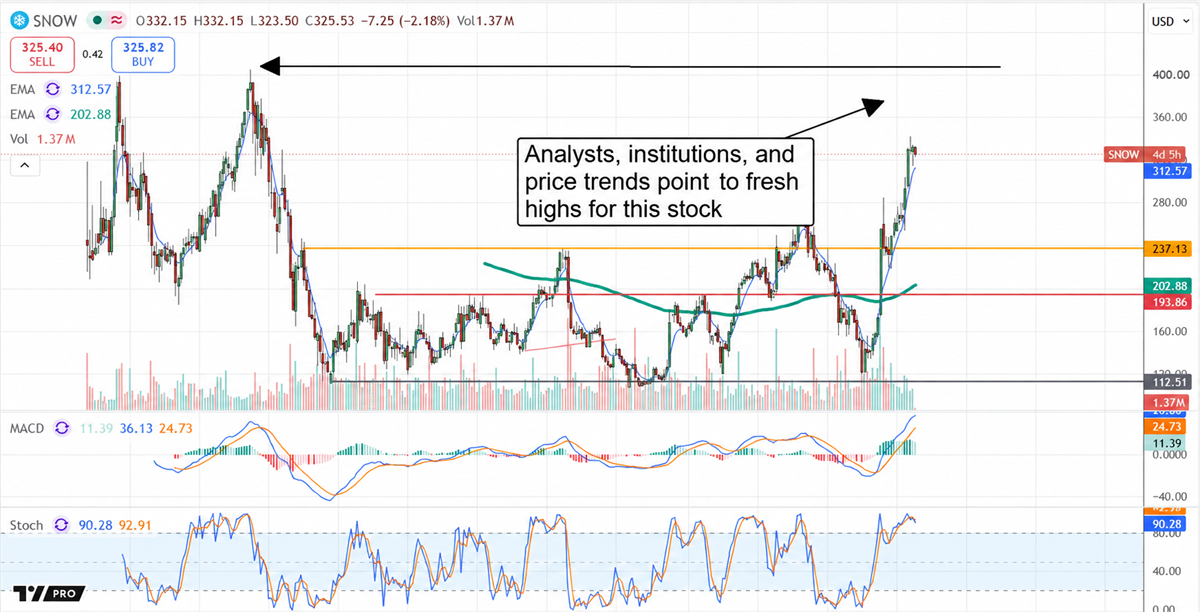
The technical setup is highly suggestive: this market is making a run to reclaim its post-IPO highs. The question is whether it can keep rallying, and the odds are high that it can, given the melt-up underway. Price action since June includes a robust upswing of about $110, or 50% upside for mid-June buyers, and the rally is likely to continue based on August price action. August’s price action includes several weeks of sideways movement near the highs, a consolidation resembling a bull-flag continuation signal.
The bull flag is a strong signal that the trend will continue and typically marks the halfway point in the rally. That leaves another $110 of potential upside, assuming the pattern confirms with a fresh high following the earnings report. In this scenario, SNOW’s share price could reach a fresh all-time high around $440 within two to three months of the break. The risk is that Snowflake’s sudden rise and the growing expectation of strength set the market up for a sell-the-news event or worse, outright disappointment.
SaaS-pocalypse Fears Were Overblown
While fear of AI disruption remains a risk, the fear-driven sell-off was overblown. Snowflake’s Q1 results showed strong demand for its services, with growth outperforming expectations and internal signals pointing to sustained strength in the coming quarters. The reality is that Snowflake’s data-centric, multicloud/cross-cloud capabilities and Cortex AI are better positioned to deploy AI than AI is positioned to disrupt them.
Snowflake’s customers are using its tools to structure data for custom AI applications, and they are becoming a critical software layer. Enterprises in heavily governed industries need reliable, secure AI functionality with no hallucinations, and that is what Snowflake’s tools enable. They store company data and the governance that lets LLMs read such data for helpful context. The Cortex AI platform lets major models run natively behind its security and compliance walls, enabling enterprises to automate workflows with a variety of tools.
Among Snowflake’s biggest risks is its reliance on external infrastructure. Rather than building its own data centers, it deploys its architecture across existing hyperscale environments to manage the data therein. This provides a lower-cost framework for Snowflake but also makes the business highly susceptible to disruption. Platforms such as Amazon’s (NASDAQ: AMZN) AWS, Microsoft's (NASDAQ: MSFT) Azure, and Alphabet’s (NASDAQ: GOOGL) Google Cloud rent capacity to Snowflake, which then wraps and resells it, while also providing competing data management services.
Companies in This Article:
| Company | Current Price | Price Change | Dividend Yield | P/E Ratio | Consensus Rating | Consensus Price Target |
|---|
| Snowflake (SNOW) | $325.26 | +3.6% | N/A | -102.28 | Moderate Buy | $413.87 |

Experience
Thomas Hughes has been a contributing author for InsiderTrades.com since 2019.
- Professional Background: Thomas Hughes is the Managing Partner of Passive Market Intelligence LLC, a market research platform he launched in 2023 with the mission: “We watch the market so you don't have to.” He has worked as a blogger, stock market commentator, and independent analyst since 2010 and has been actively involved in trading and investing since 2005.
- Credentials: He holds an Associate of Arts in Culinary Technology—training that honed his discipline, attention to detail, and ability to anticipate outcomes, all of which carry over into his work as a market analyst.
- Finance Experience: Thomas has been writing about finance and investing since 2011, when he discovered it could be more than a personal passion—it could be a profession. He’s been a contributing writer for InsiderTrades.com since 2019.
- Writing Focus: He specializes in the S&P 500, small-cap stocks, dividend and high-yield strategies, consumer staples, retail, technology, oil, and cryptocurrencies. His analysis blends chart-based technical setups with key fundamental insights, helping readers identify actionable trends.
- Investment Approach: Thomas takes a hybrid approach that combines technical analysis with deep fundamental research. He often writes about macroeconomic shifts, earnings trends, and sentiment-based trading signals.
- Inspiration: Thomas first became interested in stocks after attending a seminar on how to buy and sell your own shares. That event opened his eyes to the market's potential and sparked a lifelong interest in investing.
- Fun Fact: Thomas took up model railroading by accident a few years ago—and now he can’t stop running the rails.
- Areas of Expertise: Technical and fundamental analysis, S&P 500, retail and consumer sectors, dividends, market trends
Education
Associate of Arts in Culinary Technology
